Workers are injured every year during machine maintenance—not because equipment failed, but because energy wasn’t properly controlled. In these cases, the danger wasn’t unexpected startup or sudden release of stored energy—it was the absence of a simple, repeatable safety process. Lockout tagout (LOTO) safety training exists to close that gap.
Yet too many companies treat LOTO training as a compliance checkbox—conducting rushed sessions, relying on outdated videos, or skipping hands-on drills. The result? Workers who can recite policy but freeze when faced with a real isolation scenario. True LOTO competence isn’t about memorizing steps—it’s about building muscle memory, situational awareness, and a culture where safety overrides urgency.
This guide breaks down what effective lockout tagout safety training actually looks like: the components that matter, common pitfalls, and how to turn awareness into action.
Why Lockout Tagout Training Fails (And What to Fix)
Most LOTO programs fail not because of flawed procedures, but because of weak training delivery. A technician may know in theory that a hydraulic press needs isolation, but if they’ve never practiced locking the control valve under supervision, they’re vulnerable to error during high-pressure maintenance.
Common failures include: - One-size-fits-all sessions – Training for electricians, mechanics, and operators often gets lumped together, despite different exposure levels and responsibilities. - No scenario-based practice – Watching a demo isn’t the same as isolating a conveyor belt with multiple energy sources (electrical, pneumatic, gravitational). - Infrequent refreshers – Annual reviews aren’t enough when shift workers rotate, new equipment arrives, or procedures change. - Lack of accountability – No verification that employees can demonstrate the process, not just sign a sheet.
Effective training treats LOTO as a skill, not a lecture. It includes documented demonstrations, role-specific drills, and feedback loops.
The Core Elements of High-Impact LOTO Training
To build a training program that prevents incidents, not just meets OSHA requirements, focus on these five components:
#### 1. Energy Source Identification Employees must learn to recognize all hazardous energy types: - Electrical - Pneumatic - Hydraulic - Thermal - Chemical - Gravitational (e.g., suspended loads)
A common mistake? Assuming that turning off a switch removes all risk. In reality, residual pressure in a pipeline or a raised platform on a forklift can still cause injury. Training should include site-specific examples—like identifying isolation points on a packaging line or boiler system.
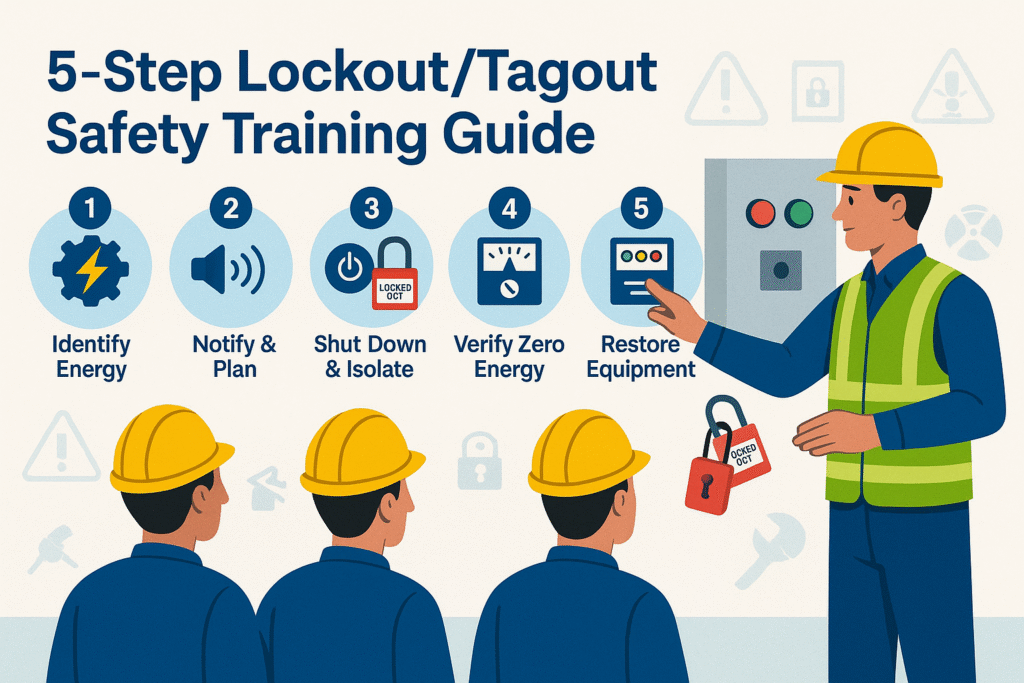
- #### 2. Step-by-Step Isolation Procedures LOTO isn’t a single action; it’s a sequence. Training must reinforce the standard workflow:
- Notify affected employees
- Shut down the machine
- Isolate all energy sources
- Apply lockout devices and tags
- Release stored energy
- Verify zero energy state
Verification is where most programs fall short. Workers must be trained to test the machine—e.g., pressing the start button after isolation—to confirm it won’t operate.
#### 3. Device Selection and Application Not all locks or tags are equal. Training should cover: - Lockout hasps for multiple workers - Valve covers and circuit breaker locks - Tags with clear warnings and worker info
Employees need to know how to use these properly—like ensuring a lock physically blocks a disconnect switch, not just hangs loosely.
#### 4. Group Lockout Protocols When multiple people work on one machine, confusion can arise. Training must clarify: - The role of the “authorized employee” who leads isolation - How each worker applies their own lock - The process for restarting (last lock off, not first)
A real-world example: On a paper mill, three mechanics worked on a dryer roll. One removed his lock early, assuming work was complete. Another started the machine remotely—resulting in a severe hand injury. Proper group LOTO training would have enforced individual accountability.
#### 5. Retraining and Competency Checks OSHA requires retraining every three years or after deviations. But high-performing sites do more: - Quarterly spot checks - Refresher drills during safety meetings - Observation of live lockout procedures
One manufacturing plant reduced LOTO errors by 70% after implementing biannual practical exams—workers had to isolate a real machine while observed.
Real-World Scenarios That Reveal Training Gaps
Training without context doesn’t stick. Use realistic situations to test understanding:
Scenario 1: Contractor Work A third-party technician arrives to repair a compressor. They’re not familiar with your LOTO system. - Does your training cover how to verify contractor knowledge? - Are temporary tags and locks available?
Scenario 2: Shift Changeovers A night technician locks out a mixer but doesn’t communicate clearly to the day crew. The morning supervisor removes the lock, assuming it was forgotten. - Does your procedure require shift交接 (handover) documentation? - Are tags required to include contact info and expected completion time?
Scenario 3: Emergency Bypass A manager demands a machine be restarted to meet a deadline, asking a worker to “just bypass the lock for a minute.” - Does your training emphasize that LOTO is non-negotiable? - Are employees empowered to stop unsafe requests?
These aren’t hypotheticals. They’re common flashpoints where weak training leads to incidents.
What OSHA Expects—and What It Doesn’t Say
OSHA’s LOTO standard (29 CFR 1910.147) mandates training, but doesn’t prescribe methods. This creates ambiguity.
What OSHA requires: - Authorized employees must be trained in implementation and inspection of energy control procedures. - Affected employees must understand the purpose of LOTO and their role. - Retraining when duties change or deficiencies are observed.
What it doesn’t require—but smart companies do: - Hands-on drills with actual equipment - Video documentation of employee demonstrations - Integration with permit-to-work systems - Use of digital LOTO platforms for tracking
Compliance is the floor, not the ceiling. Effective training goes beyond what’s legally required to build real competence.
Integrating LOTO Training Into Your Safety Culture
LOTO doesn’t exist in a vacuum. It’s part of a broader safety ecosystem. To make it stick:
Link training to audits Conduct regular LOTO audits—randomly select machines and verify isolation integrity. Use findings to refine training content. One plant discovered that 40% of locks were improperly applied. They revised training to include a “lock fit” checklist.
Empower stop-work authority Train employees that they can—and must—halt work if LOTO isn’t followed. Reinforce this with leadership messaging. When a junior technician stopped a startup because a tag was missing, recognize that publicly.

Use visual cues Post LOTO flowcharts near high-risk equipment. Include photos of correct lock application. At one facility, they laminated step-by-step guides with QR codes linking to training videos.
Track near-misses Encourage reporting of LOTO close calls—like a lock removed prematurely or a tag left in place after work. Analyze trends and adjust training accordingly.
Tools to Support LOTO Training (Not Replace It)
While no tool substitutes for solid training, these resources enhance it:
| Tool | Use Case | Limitations |
|---|---|---|
| LOTO procedure software | Digitize and standardize isolation steps | Requires upfront setup and maintenance |
| Training kiosks | Deliver consistent modules across shifts | Lacks hands-on practice |
| Smart lockout stations | Store locks, tags, and instructions centrally | High initial cost |
| Mobile LOTO apps | Capture photos of applied locks, track compliance | Dependent on worker honesty |
| Augmented reality (AR) simulators | Train on virtual machines without risk | Limited availability, high cost |
The best approach combines digital tools with live practice. Use software to manage documentation, but require in-person validation.
Building a Sustainable LOTO Training Program
The goal isn’t just initial compliance—it’s lasting behavior change. To do that:
- Customize content – Don’t use generic LOTO videos. Film your own equipment, your procedures, your people.
- Assign owners – Designate a LOTO program manager responsible for updates, audits, and training quality.
- Measure outcomes – Track LOTO audit scores, near-misses, and training completion rates.
- Iterate – Review training effectiveness quarterly. Replace what isn’t working.
One refinery cut LOTO violations by 85% over 18 months by treating training as a continuous process—not a one-time event.
Effective lockout tagout safety training doesn’t just teach steps—it builds judgment. It turns policy into instinct. Workers shouldn’t just know how to lock a machine—they should feel uneasy operating without it.
Start by auditing your current program: watch a real isolation. Is every step followed? Is verification done? If not, the fix isn’t more rules—it’s better training. Redesign your sessions around practice, accountability, and real-world relevance.
Because when a machine starts unexpectedly, it’s not the procedure that saves a life—it’s what the worker does in the moment. And that only comes from real training.
Frequently Asked Questions
What is the difference between an authorized and affected employee in LOTO? Authorized employees implement the energy control program and apply locks. Affected employees operate or use the equipment but don’t perform maintenance.
How often is LOTO retraining required? OSHA requires retraining at least every three years, or whenever there’s a change in job duties, equipment, or if a safety inspection reveals a deficiency.
Can tags be used alone without locks? Only if the tag provides equivalent protection—rare in industrial settings. OSHA generally requires lockout devices; tags alone are permitted only under specific conditions.
Who is responsible for enforcing LOTO procedures? The employer is responsible for establishing and enforcing the program. Supervisors and safety officers ensure compliance on the ground.
What should a LOTO tag include? Employee name, department, date, time, reason for lockout, and contact information.
Is group lockout required for multiple workers? Yes. Each worker must apply their own lock. A single lock or shared hasp without individual control violates OSHA standards.
Can temporary contractors perform LOTO? Yes, but only if they are trained and authorized under your program. Contractors must follow your procedures, not their own.
FAQ
What should you look for in Lockout Tagout Safety Training: What Actually Works? Focus on relevance, practical value, and how well the solution matches real user intent.
Is Lockout Tagout Safety Training: What Actually Works suitable for beginners? That depends on the workflow, but a clear step-by-step approach usually makes it easier to start.
How do you compare options around Lockout Tagout Safety Training: What Actually Works? Compare features, trust signals, limitations, pricing, and ease of implementation.
What mistakes should you avoid? Avoid generic choices, weak validation, and decisions based only on marketing claims.
What is the next best step? Shortlist the most relevant options, validate them quickly, and refine from real-world results.